Adaptive AI Interviewer
A protocol-guided AI interviewer that helps research teams conduct adaptive semi-structured interviews while tracking topic coverage, conversational depth, and the remaining time budget.
The problem
Protocol-based interviews are difficult to scale without losing the judgment skilled interviewers use to balance required questions, productive follow-ups, unexpected insights, and limited time. Ordinary chatbots give researchers none of that: no reliable protocol coverage, no auditability, no study-management controls.
The approach
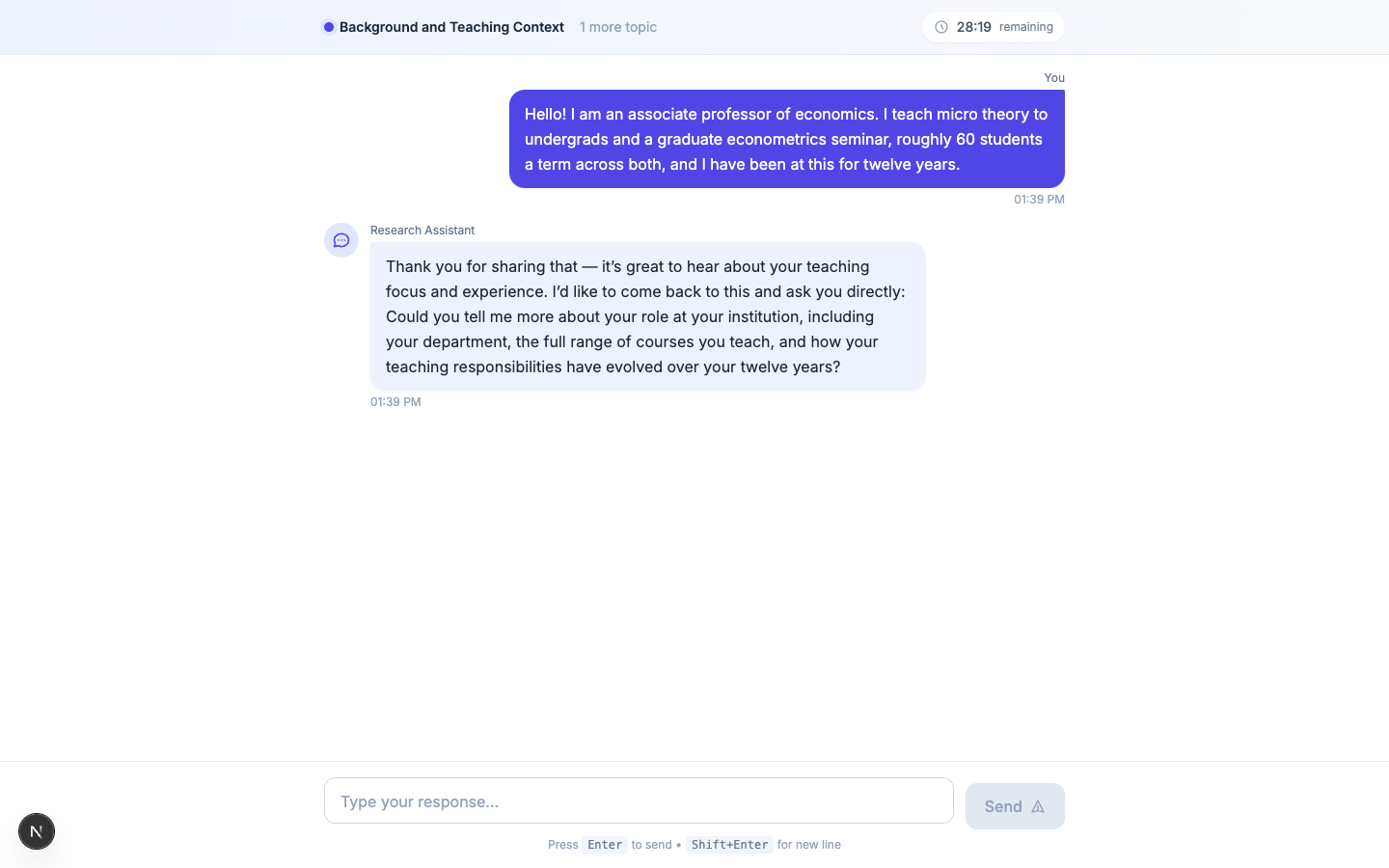
The system treats an interview as a coverage and information-acquisition problem. A locally hosted language model conducts the conversation while an orchestration engine decomposes responses into claims, matches them to protocol goals, tracks coverage and novelty, and uses a transparent policy layer to decide whether to probe, ask the next protocol question, change topics, or close. Participant consent and lifecycle controls sit beside researcher tools for protocol authoring, live monitoring, transcript review, and export.
Research basis
The platform is the instrument side of the lab’s information-measurement research: if you can measure what an interview elicited, you can study whether an adaptive interviewer elicits more of it. Its faculty generative-AI interview protocol supports the lab’s NSF CAREER Minds and Machines project, and the system connects the lab’s qualitative methods, mental-model elicitation, and human-centered AI work in one experimental testbed.
What it does today
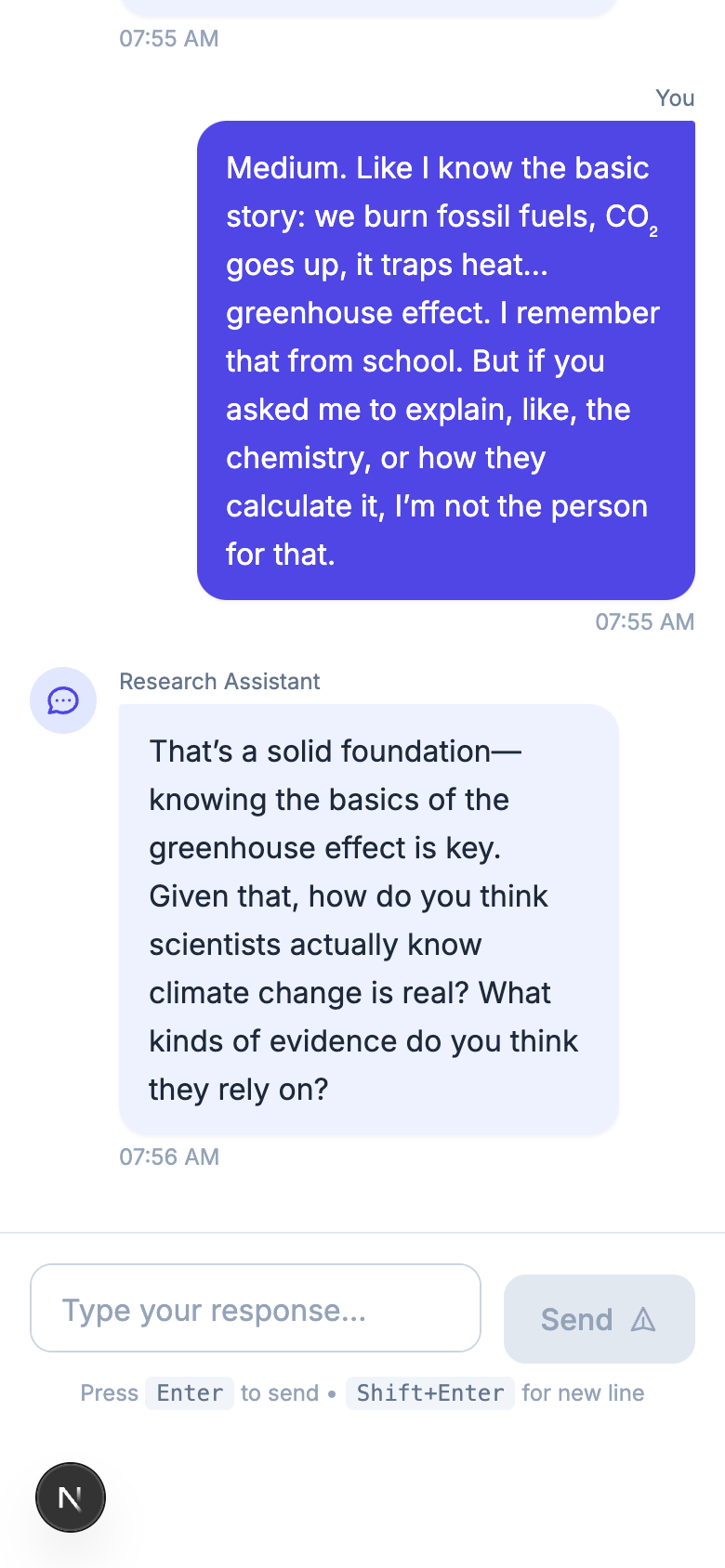
- Conducts protocol-guided interviews with a locally hosted model, showing participants the current topic, coverage, and time remaining.
- Decomposes responses into claims, matches them to protocol goals, and tracks coverage and novelty as the conversation moves.
- Chooses the next interview action (probe, next question, topic change, or close) through a transparent policy layer.
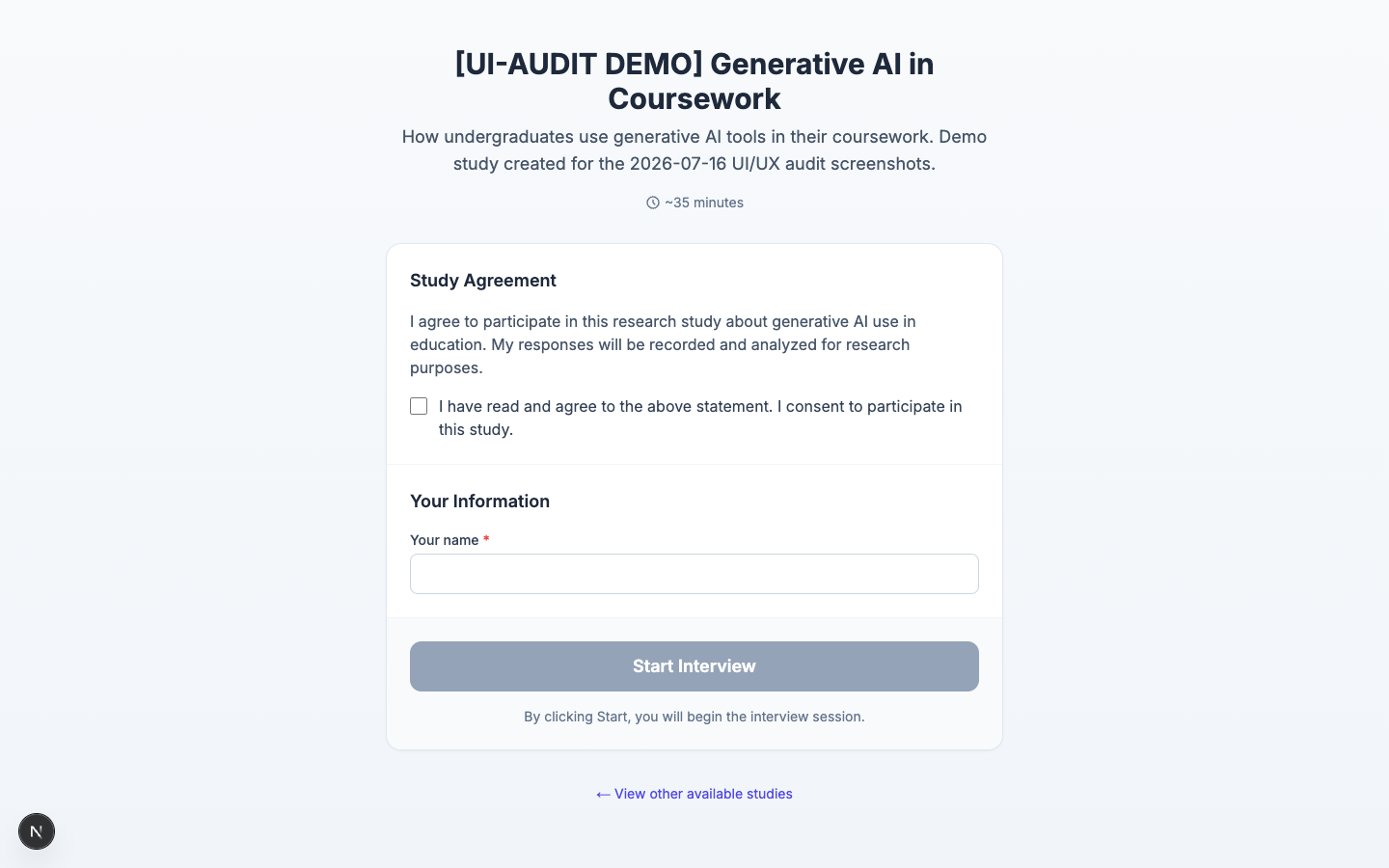
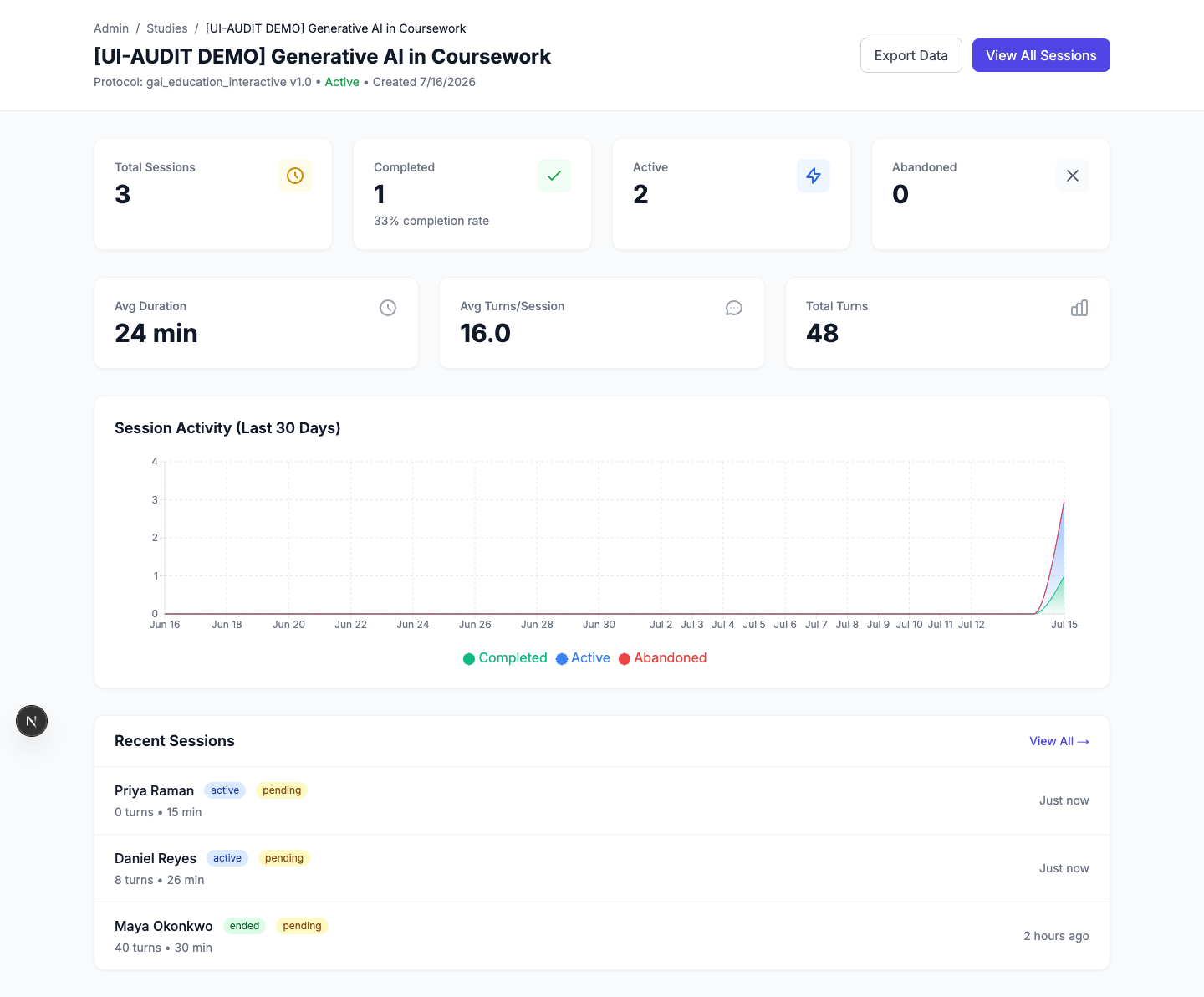
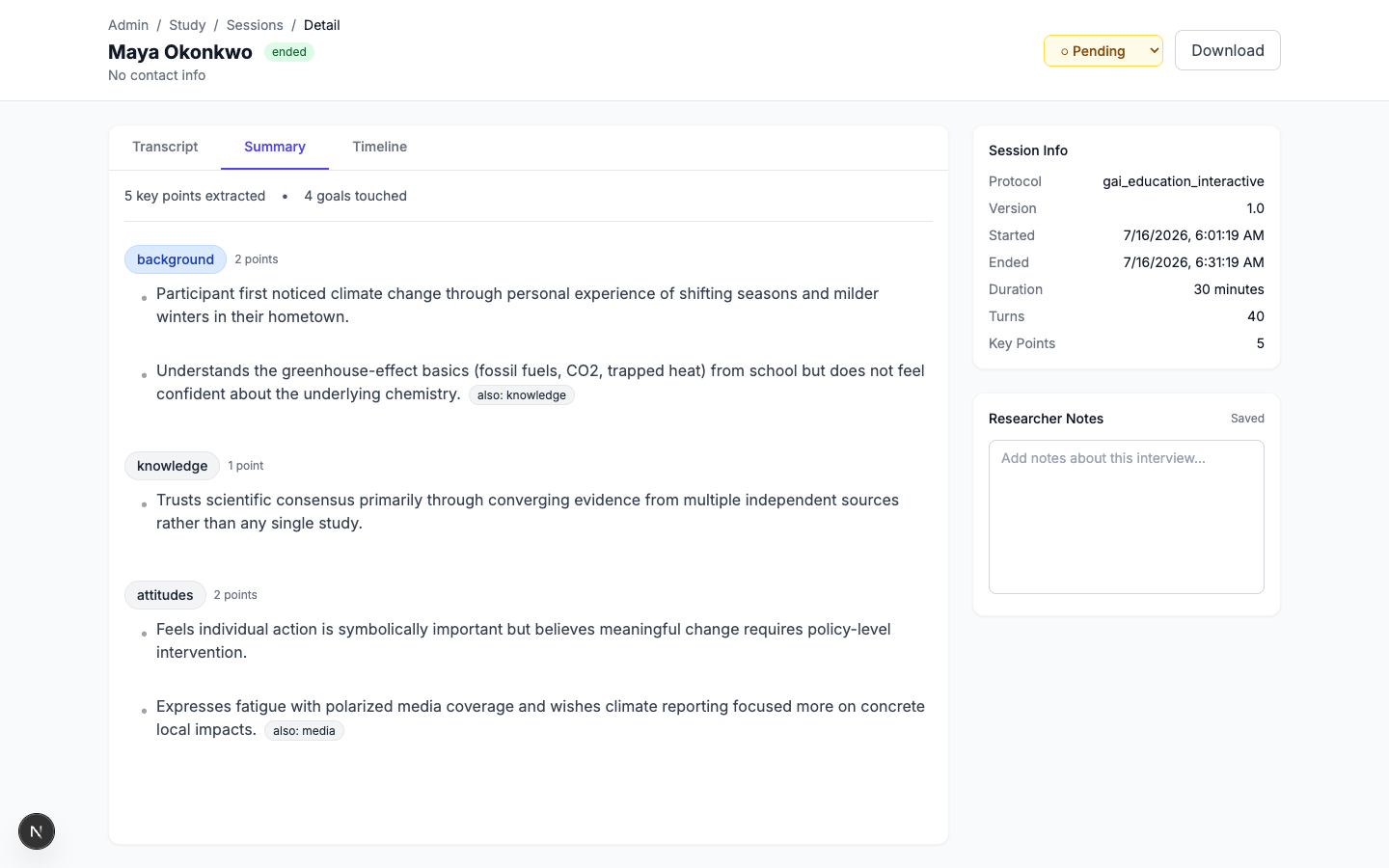
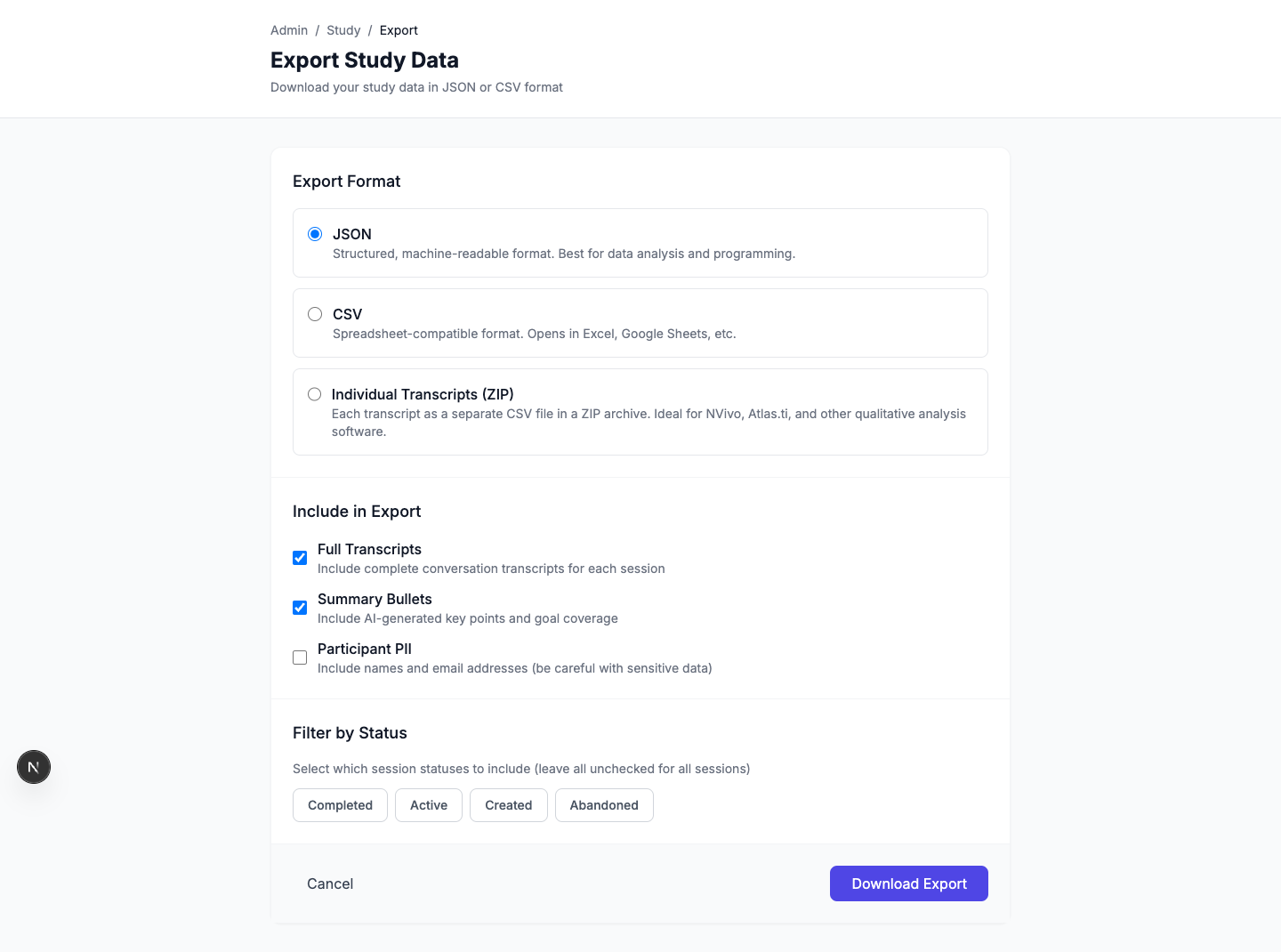
- Gives participants consent, pause, and withdrawal controls; gives researchers protocol versioning, study configuration, live monitoring, transcript and summary review, and exports with PII opt-in.
- Carries a July 2026 verification record: 536 backend and 67 frontend tests, plus lint, type, build, migration, mobile, streaming, and export checks.
What it does not do
- Not a public product: no public URL, no durable production deployment, and no way for outside researchers to run studies on it today.
- No completed participant field pilot of this platform, and no documented external user feedback.
Inside the prototype
Evidence
Verified working prototype
A July 2026 verification record reports 536 non-live backend tests and 67 frontend tests passing, alongside lint, type checking, production build, migration, mobile, browser, streaming, and export checks.
As of 2026-07-31
Complete participant and researcher journeys
Study entry, consent, adaptive interview, coverage feedback, pause and withdrawal, and completion all run locally, as do researcher protocol, monitoring, review, and export workflows; twenty-nine UI-audit screenshots document the surfaces, six published here from seeded demo data.
As of 2026-08-28
What we are not claiming
- The interview policy is research-grade: coverage calibration, claim granularity, contradiction handling, and evaluator validity are open research problems, not solved ones.
- A draft manuscript and pilot experiments exist but are unpublished; nothing here is a validated instrument.
- Some measurement experiments use a public, participant-consented interview corpus; that is not evidence this platform has completed a field pilot.
Responsible use, privacy, and rights
- The repository, study protocols, consent materials, and any future participant data stay private. Published captures use seeded demonstration content only.
- Field use would require IRB approval and outcome-grounded evaluation of the interview policy first.
Where it came from
- CAREER: Minds and Machines: Exploring Engineering Faculty Member Mental Models of Generative AI and Instructional Decisions
National Science Foundation CAREER Award · 2024-2028
More from the Studio
All entriesUse it
Course Sphynx
A faculty-facing platform for helping instructors redesign courses through guided, transformation-oriented support.
Explore it
GATOS qualitative analysis workflow
A research workflow for using open-source generative AI and machine learning to support inductive qualitative codebook development.
Explore it
CATS QDA
A local-first workspace where qualitative researchers analyze sensitive interview data with AI assistance they can inspect, override, and audit.