Cadence
A browser-based platform for longitudinal and experience-sampling research: recurring text and voice reflections from participants, with scheduling, consent, and clean export built in. Cadence is a working name.
The problem
Survey systems are built for structured questions, so researchers collecting recurring open-ended reflections improvise with voice memos, email, and cloud folders, losing scheduling, consent tracking, provenance, and any clean path to analysis.
The approach
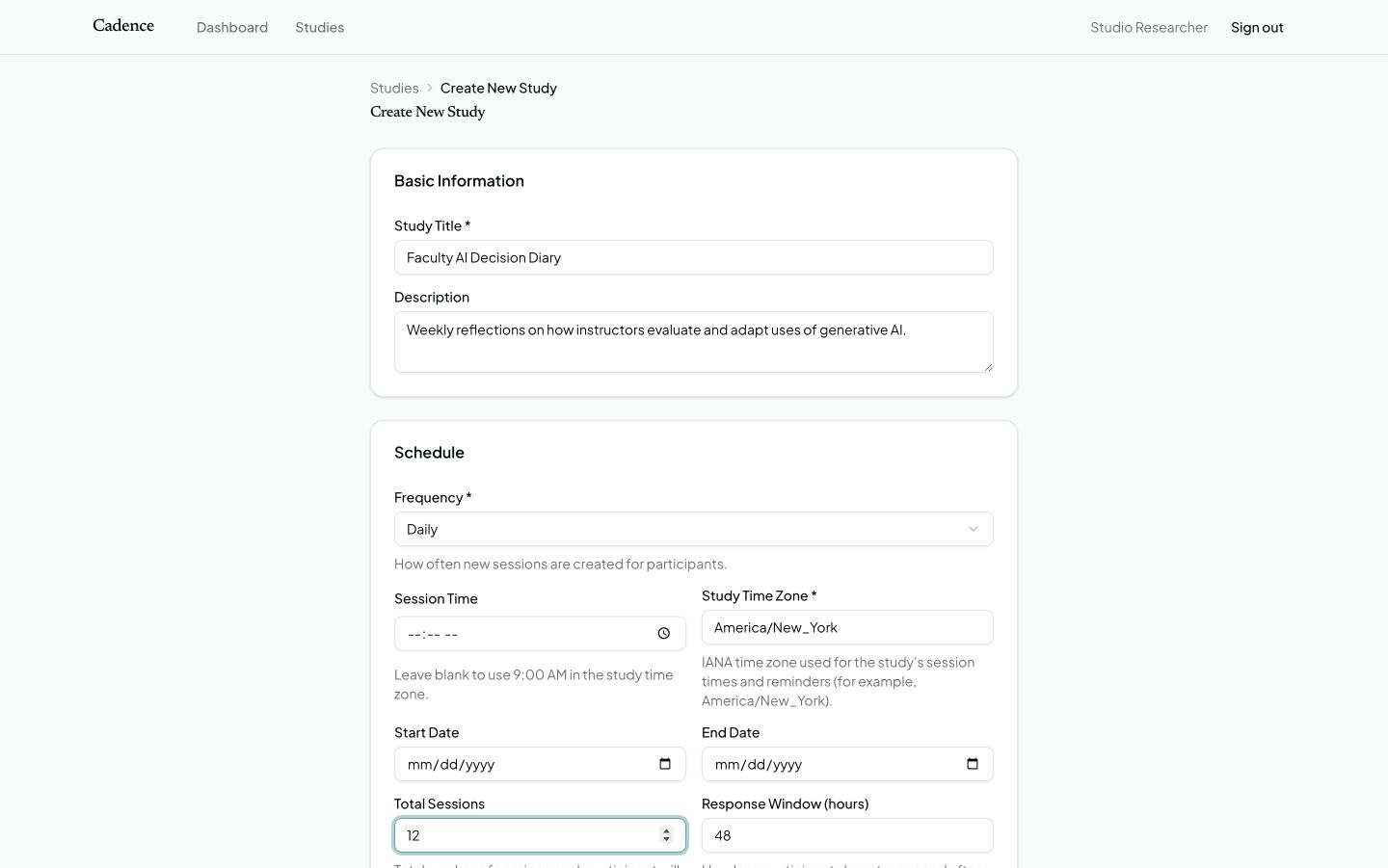
Researchers configure recurring studies with ordered text and audio prompts, response windows, and time zones; participants respond through an app-free web interface on any device. Enrollment, consent, participation monitoring, response review, and structured CSV and audio export live in one place, designed to feed the lab’s downstream transcription and qualitative-analysis workflows.
Research basis
Cadence is the intake end of the lab’s qualitative pipeline: it collects the recurring reflections that methods like GATOS analyze downstream. The demonstration studies in the screenshots (weekly engineering design-decision reflections, a faculty AI decision diary) are the lab’s actual research questions, configured as studies.
What it does today
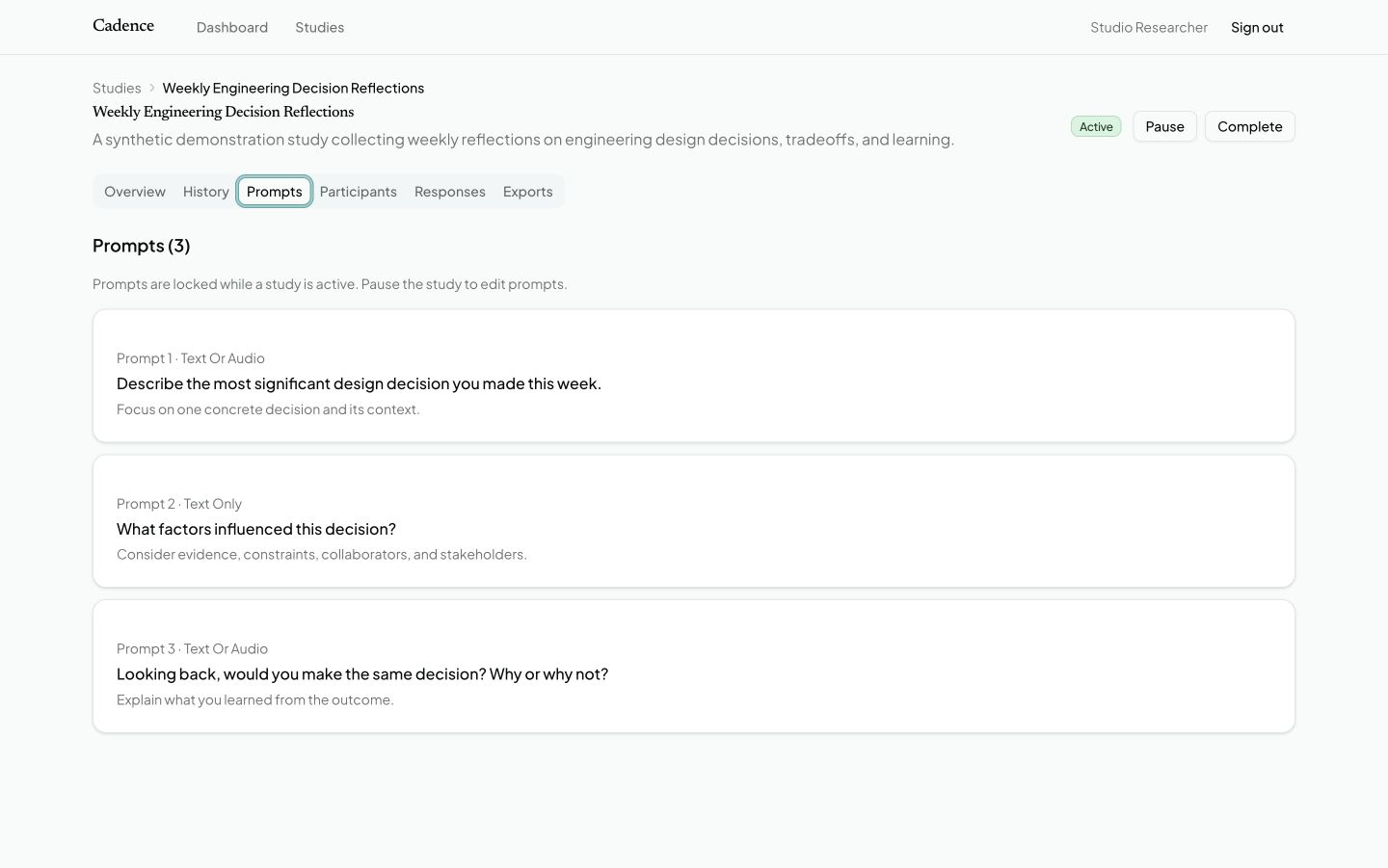
- Configures recurring studies with ordered text/audio prompts, daily or weekly frequency, time zones, session counts, and response windows.
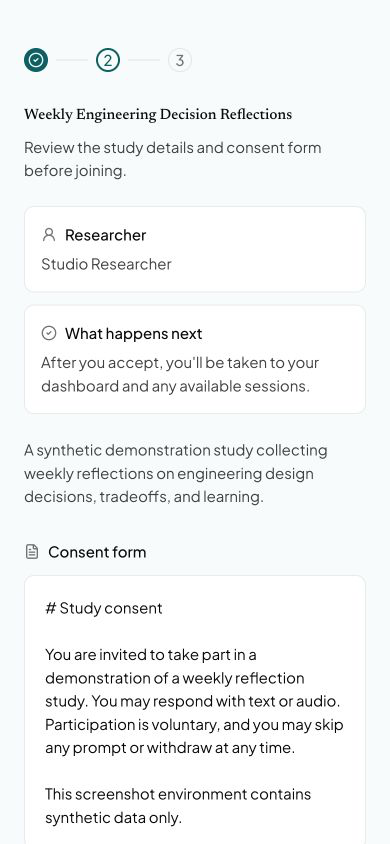
- Enrolls participants with recorded consent and tracks participation across the study lifecycle.
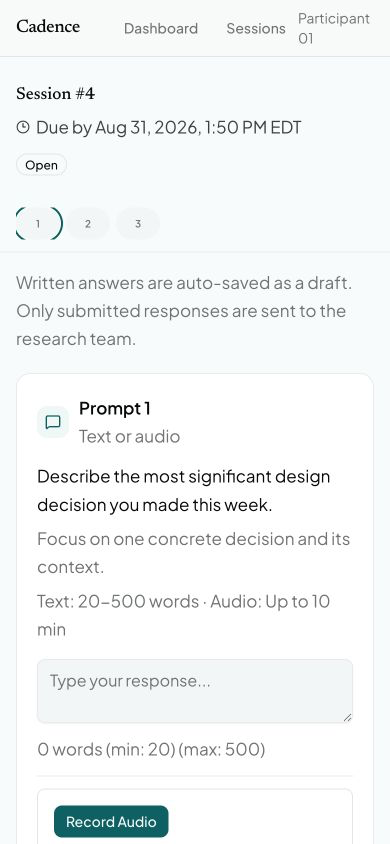
- Gives participants an app-free web interface on any device, with typed or recorded responses and auto-saved drafts.
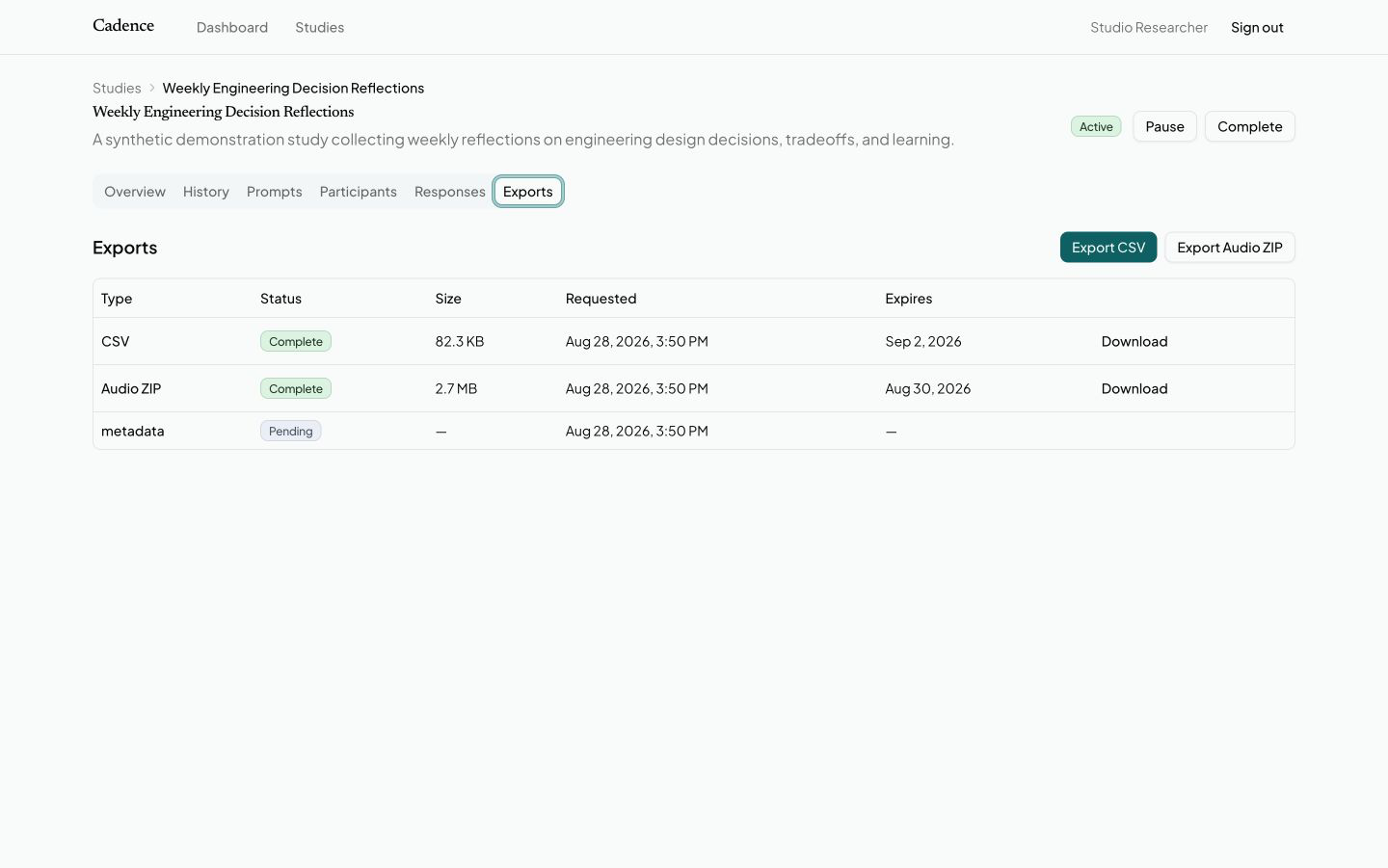
- Lets researchers review submissions longitudinally and export structured CSV data and audio archives with expiring links.
- Runs on a full research stack (background processing, object storage, audio transcoding) with automated tests and documented data-flow and trust-boundary diagrams.
What it does not do
- Pre-pilot: no completed deployment, no real-participant study, and no public product. Production hosting, verified email delivery, monitoring, and backup evidence remain unfinished.
- No AI transcription or analysis pipeline yet; Cadence is designed to feed those workflows, not to perform them.
- A routing issue currently sends unauthenticated participant entry paths to the researcher login; the RA documented it as a fix required before any pilot.
Inside the prototype
Evidence
Working pre-pilot prototype
Researcher and participant interfaces, backend APIs, migrations, and background processing exist and run locally; review-time checks passed lint, type checking, and 39 frontend plus 57 backend tests.
As of 2026-08-28
Privacy-safe capture set
Fourteen screenshots across the researcher desktop and participant mobile journeys, from a production frontend build against an isolated synthetic database, with the fixture labeled synthetic inside the product, including in the consent form.
As of 2026-08-28
Documented engineering posture
System-context, data-flow, data-lifecycle, and trust-boundary diagrams, plus audits and remediation plans, are recorded in the repository alongside the code.
As of 2026-08-28
What we are not claiming
- Cadence has never collected real participant data. Every screen shown is a synthetic demonstration, and the next milestone, a supervised production rehearsal, comes before any real study.
- “Cadence” is a working name, not a product brand; clearance would be required before presenting it as one.
- No grant attribution is claimed: the project’s originating application is documented internally but unconfirmed, so the entry names none.
Responsible use, privacy, and rights
- Future participant recordings, transcripts, consent records, and identifiers are restricted; security audits and threat-model detail stay private.
- Real studies require the applicable IRB approvals and a completed production rehearsal first.
Where it came from
- Characterizing Design Decisions with LLMs
Seed Project (Unfunded) · 2025–present
- CAREER: Minds and Machines: Exploring Engineering Faculty Member Mental Models of Generative AI and Instructional Decisions
National Science Foundation CAREER Award · 2024-2028
More from the Studio
All entriesUse it
Course Sphynx
A faculty-facing platform for helping instructors redesign courses through guided, transformation-oriented support.
Explore it
GATOS qualitative analysis workflow
A research workflow for using open-source generative AI and machine learning to support inductive qualitative codebook development.
Explore it
CATS QDA
A local-first workspace where qualitative researchers analyze sensitive interview data with AI assistance they can inspect, override, and audit.