Design Team Meeting Intelligence
A local-first research instrument that turns engineering design-team meetings into traceable evidence about participation, deliberation, and responsible design.
The problem
Important evidence about how engineering teams reason, participate, make decisions, and consider broader impacts is buried in long meeting recordings that are too long to review and too rich to discard.
The approach
Meeting audio becomes a speaker-diarized transcript, editable structured notes, deterministic participation measures, and multi-pass local AI analyses of design process and social, economic, environmental, and ethical (SEEE) engagement. Every interpretation is displayed beside the timestamped passage it came from, so researchers inspect evidence rather than accept summaries.
Research basis
DTMI grows out of the lab’s research on engineering design cognition, team interaction, and the societal dimensions of design. The course-configurable SEEE framework turns those research constructs into something an instructor can adapt, and analysis records retain model, prompt-hash, and version metadata so interpretations stay traceable to how they were produced.
What it does today
- Organizes courses, teams, and meetings with local and batch audio ingestion.
- Produces speaker-diarized transcripts with editable structured notes.
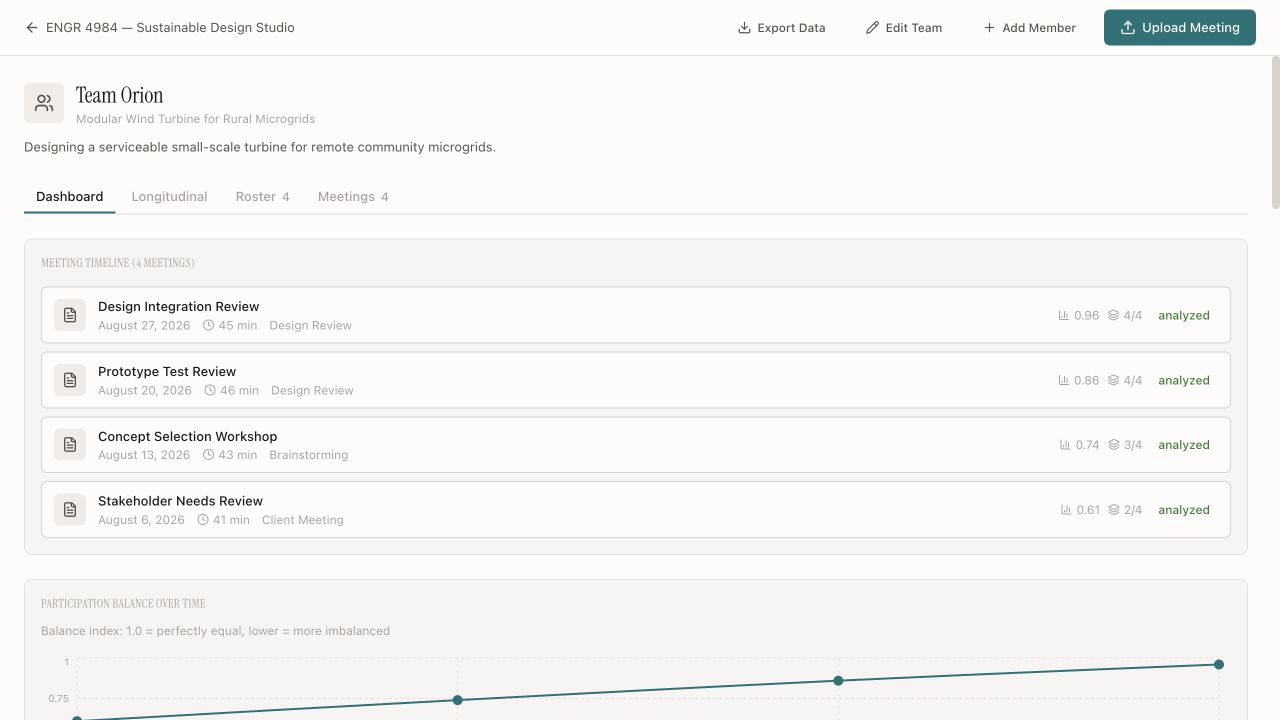
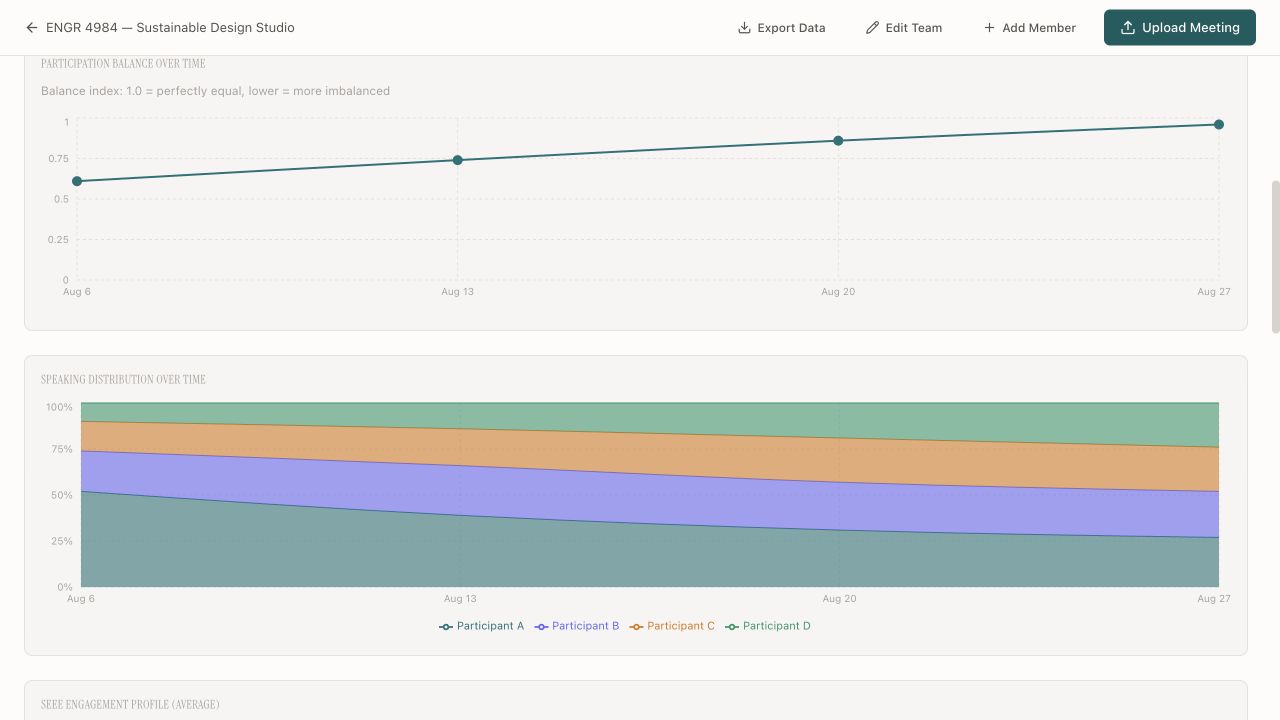
- Computes deterministic participation measures (balance index, speaking distribution, turn counts) and tracks them across meetings.
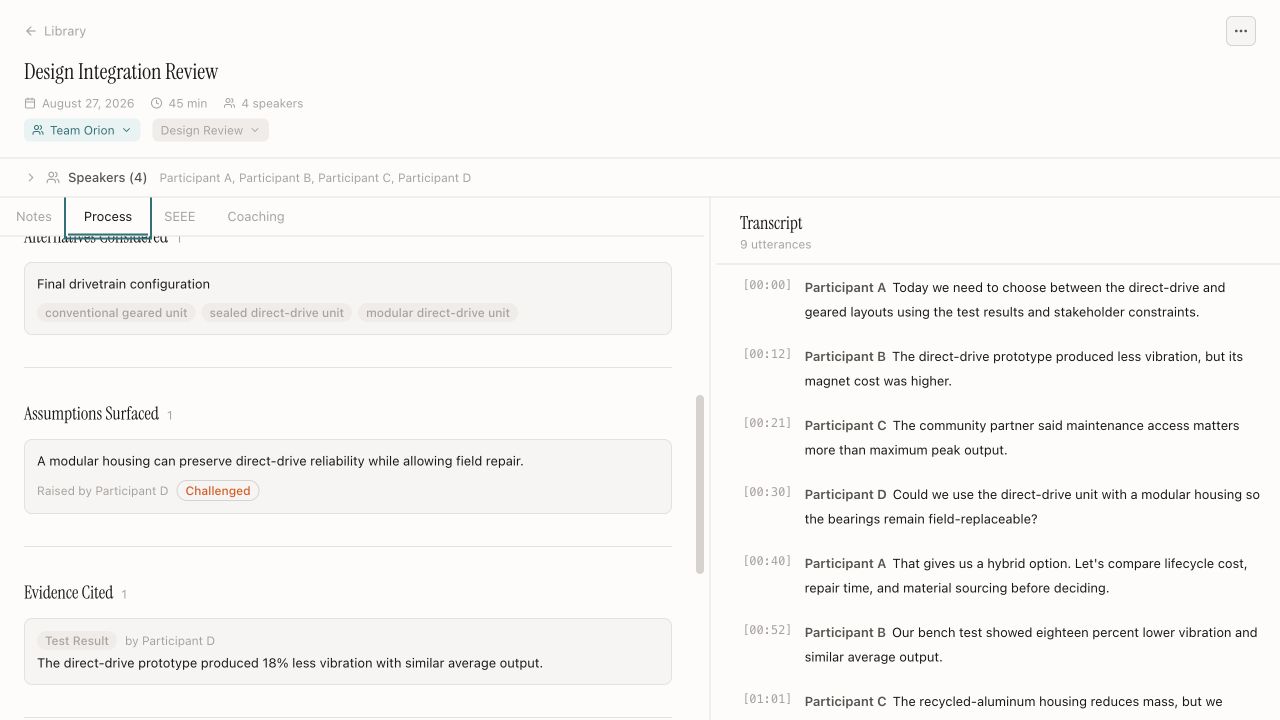
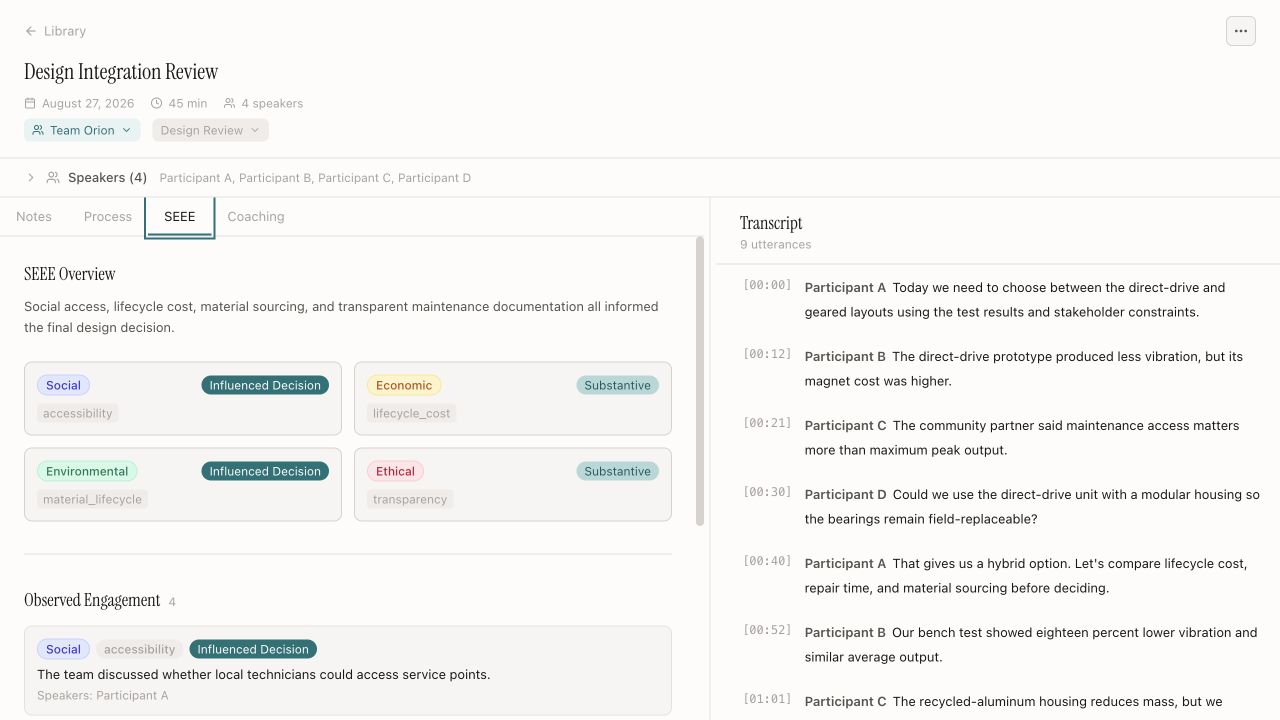
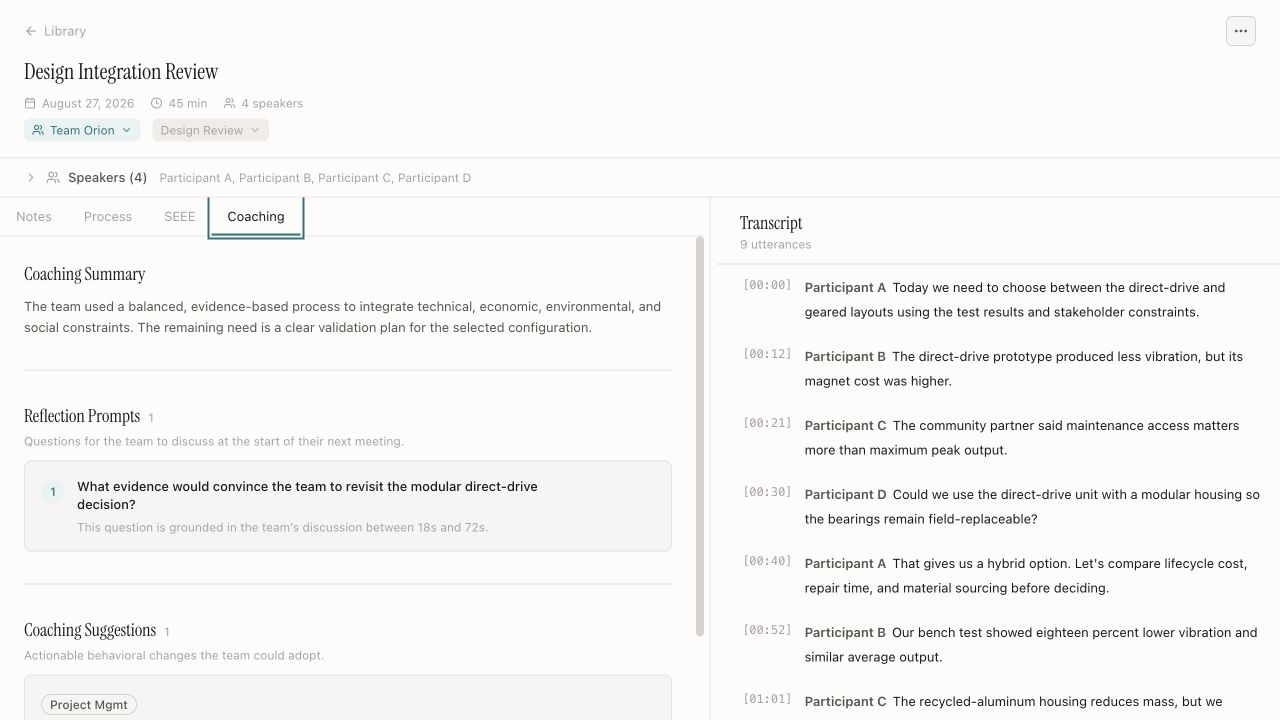
- Runs multi-pass local analyses of design process (alternatives, assumptions, evidence use) and course-configurable SEEE engagement, displayed beside their source passages.
- Prototypes evidence-linked reflection prompts and longitudinal team synthesis.
- Tracks per-participant recording and analysis consent.
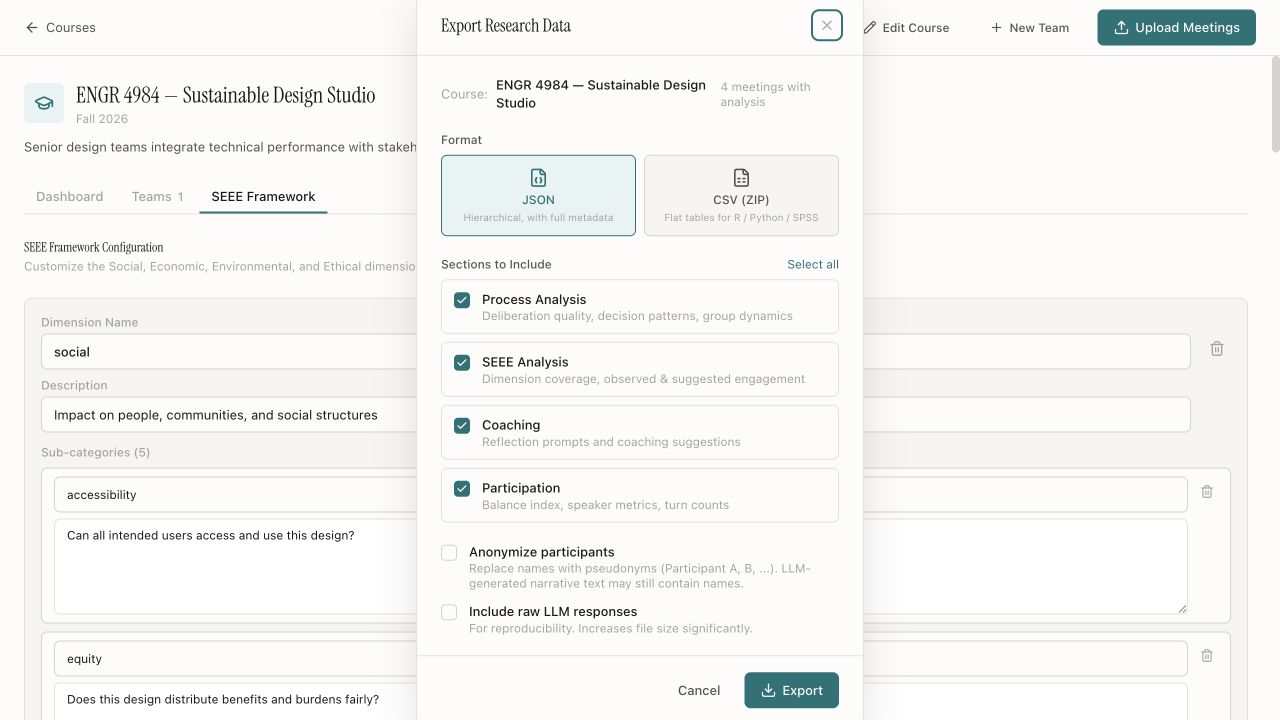
- Exports structured JSON/CSV with model, prompt-hash, and version metadata for reproducibility.
What it does not do
- Not hosted and has no authentication; it is bound to a trusted local machine as a single instance.
- No completed external pilot, course deployment, or publishable user-feedback study.
- Export correctness is still being verified.
Inside the prototype
Evidence
Working instrument, end to end
Fifteen screenshots from the production frontend against an isolated synthetic fixture, spanning ingestion, transcripts, analyses, consent, longitudinal views, and export. The fixture generator refuses to touch the live data directory.
As of 2026-08-28
Documented design, not just code
Architecture, five-pass analysis framework, and the pending validation-gate protocol are written down in the repository alongside backend and frontend test suites.
As of 2026-08-28
Validation honestly gated
The project defines its own quality bar, at least 75% precision per LLM pass under formal human review, and treats analysis outputs as experimental until it is met.
As of 2026-08-28
What we are not claiming
- The AI-generated process, SEEE, longitudinal, and coaching interpretations are experimental outputs, not validated research measures. A formal human-review gate of at least 75% precision for each analysis pass has not yet been run, and research conclusions should not rest on these fields until it has.
- The deterministic participation measures are reliable arithmetic over the transcript, but their standing as constructs (what participation balance means pedagogically) is a research question, not a settled fact.
- Anonymized exports may retain participant names inside generated narrative text; the structured identifiers are pseudonymized, the prose is not guaranteed to be.
Responsible use, privacy, and rights
- Student recordings, transcripts, identities, consent records, and model logs are never published; only the synthetic fixture appears in public materials.
- Use with real course data stays within consent tracking, IRB terms, and the local trust boundary.
Where it came from
- Characterizing Design Decisions with LLMs
Seed Project (Unfunded) · 2025–present
- Design for Sustainability: How Mental Models of Social-Ecological Systems Shape Engineering Design Decisions
National Science Foundation Engineering Education Centers · 2023-2027
More from the Studio
All entriesUse it
Course Sphynx
A faculty-facing platform for helping instructors redesign courses through guided, transformation-oriented support.
Explore it
GATOS qualitative analysis workflow
A research workflow for using open-source generative AI and machine learning to support inductive qualitative codebook development.
Explore it
CATS QDA
A local-first workspace where qualitative researchers analyze sensitive interview data with AI assistance they can inspect, override, and audit.