
DocDoc
An agentic research and writing workbench: one place to search literature across providers, ingest and query a corpus, run tool-using research agents, and write with citations that trace back to source passages. DocDoc is a working name.
The problem
Research work fragments across scholarly search, document storage, extraction, synthesis, citation management, and writing. General-purpose AI writing tools accelerate isolated steps, but they do not know a lab’s corpus and rarely offer reliable traceability from a generated claim back to the passage that supports it.
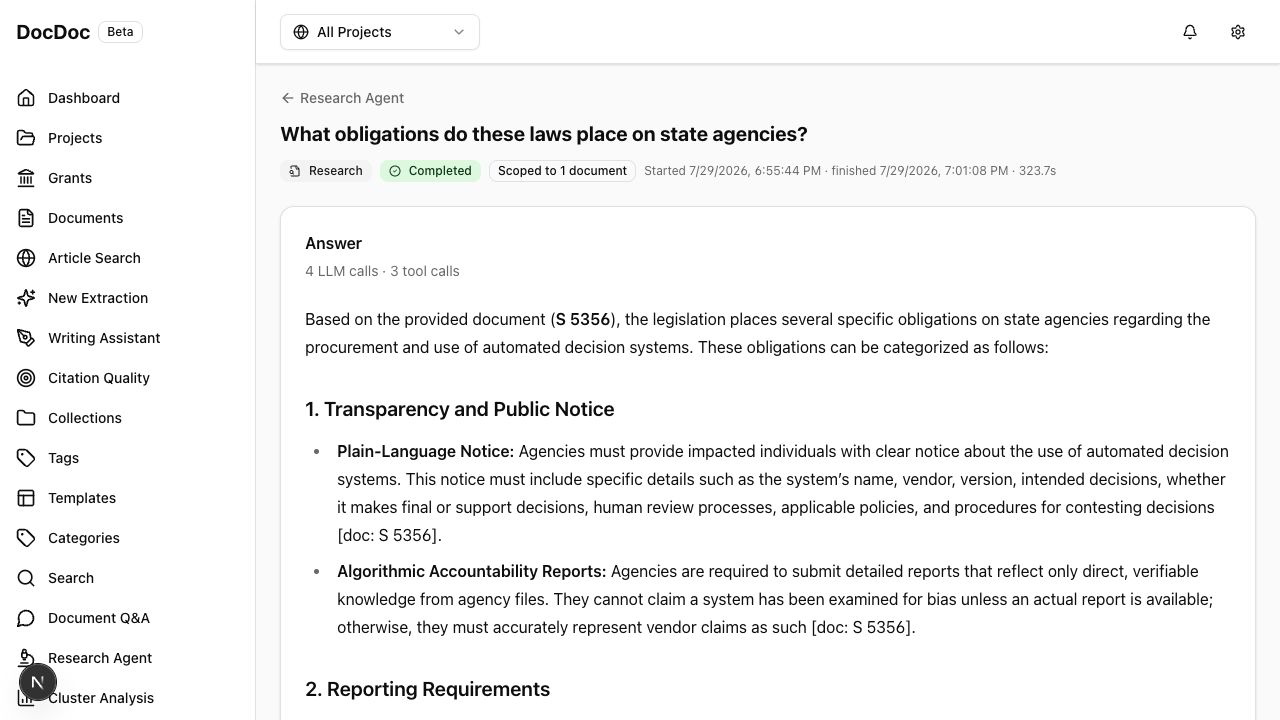
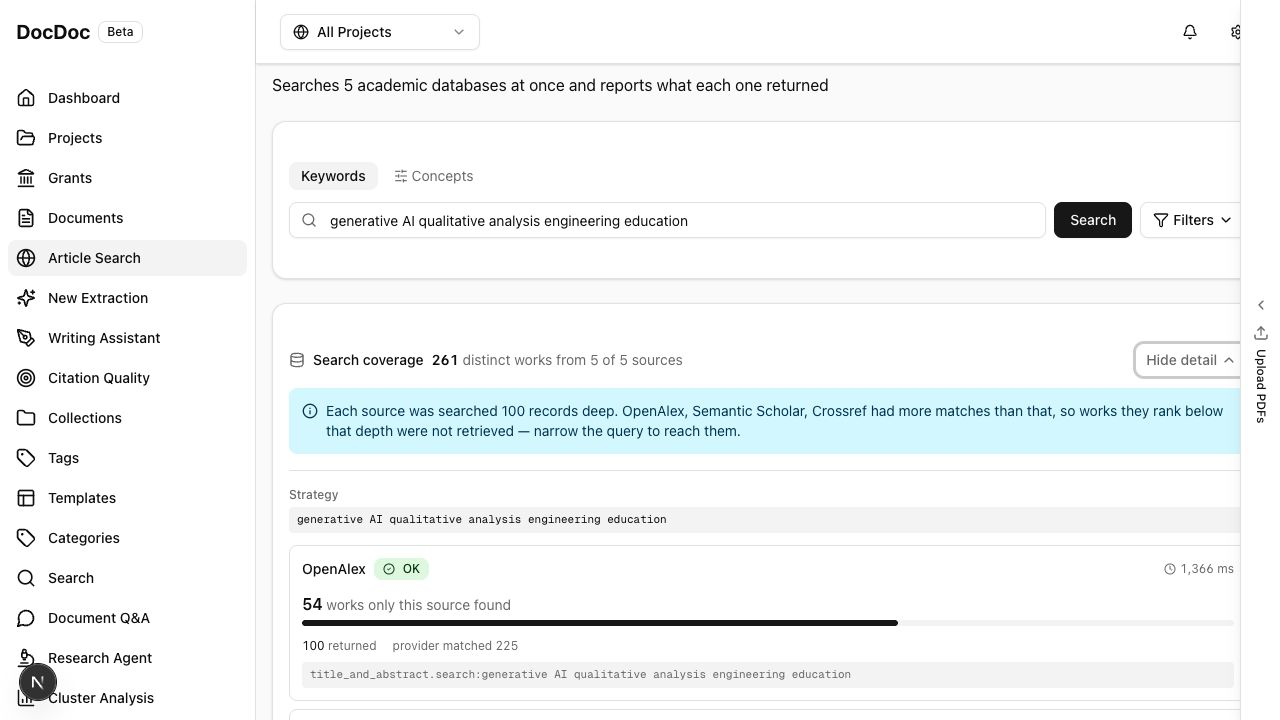
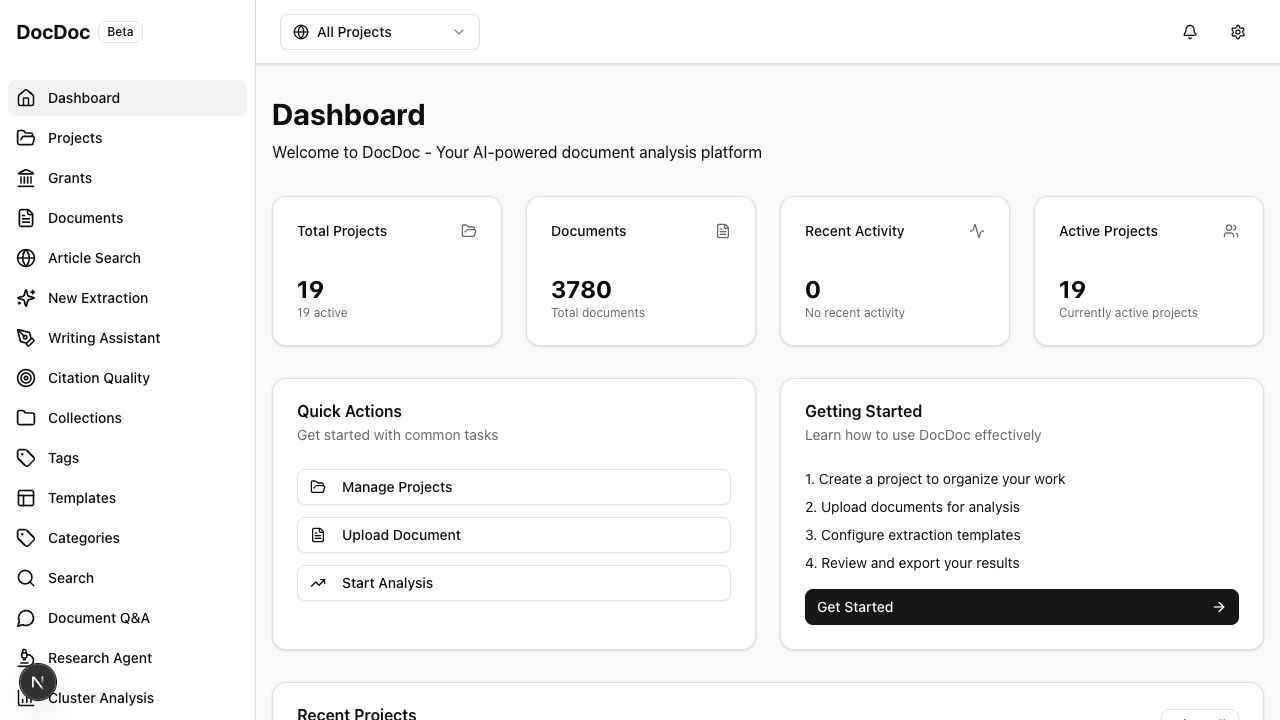
DocDoc keeps the whole path in one system: it ingests and organizes document collections; parses, chunks, embeds, and searches them; queries multiple scholarly providers and reports what each returned; runs tool-using research agents whose activity and citations stay visible; and supports rich-text and LaTeX writing with references. Inference runs local-first through Ollama, though some workflows call external scholarly services.
What it looks like
Research basis
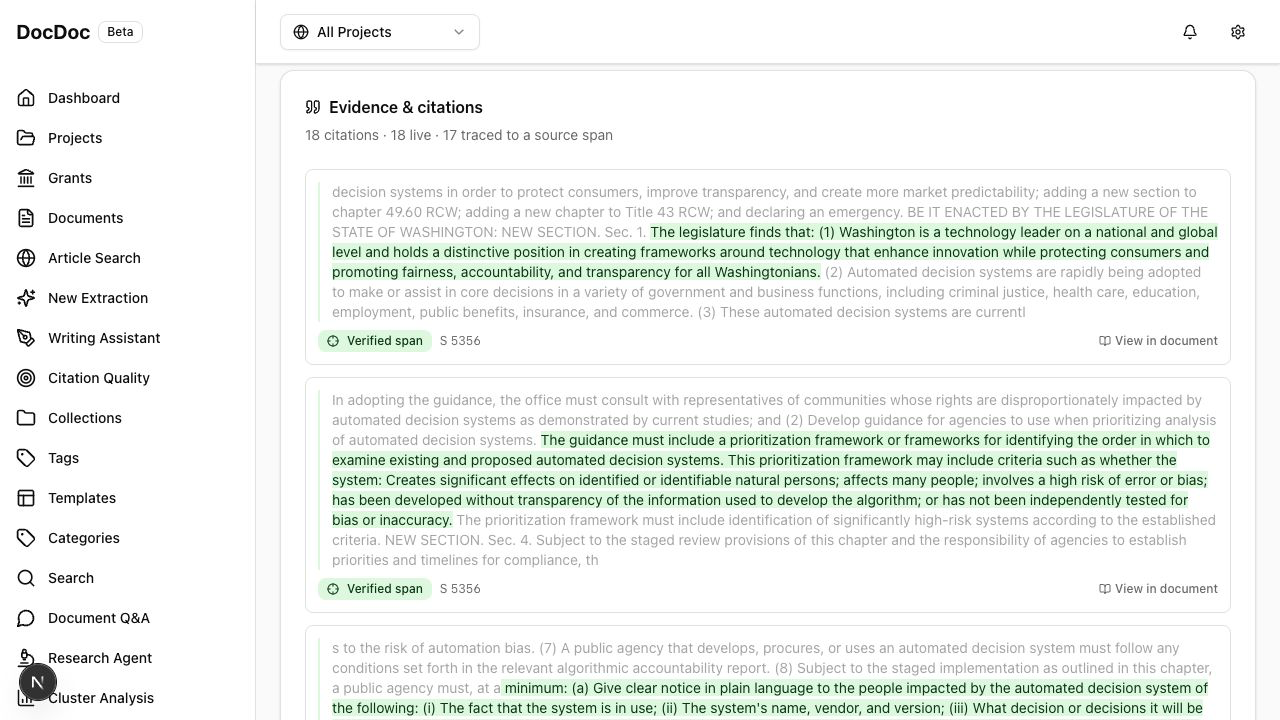
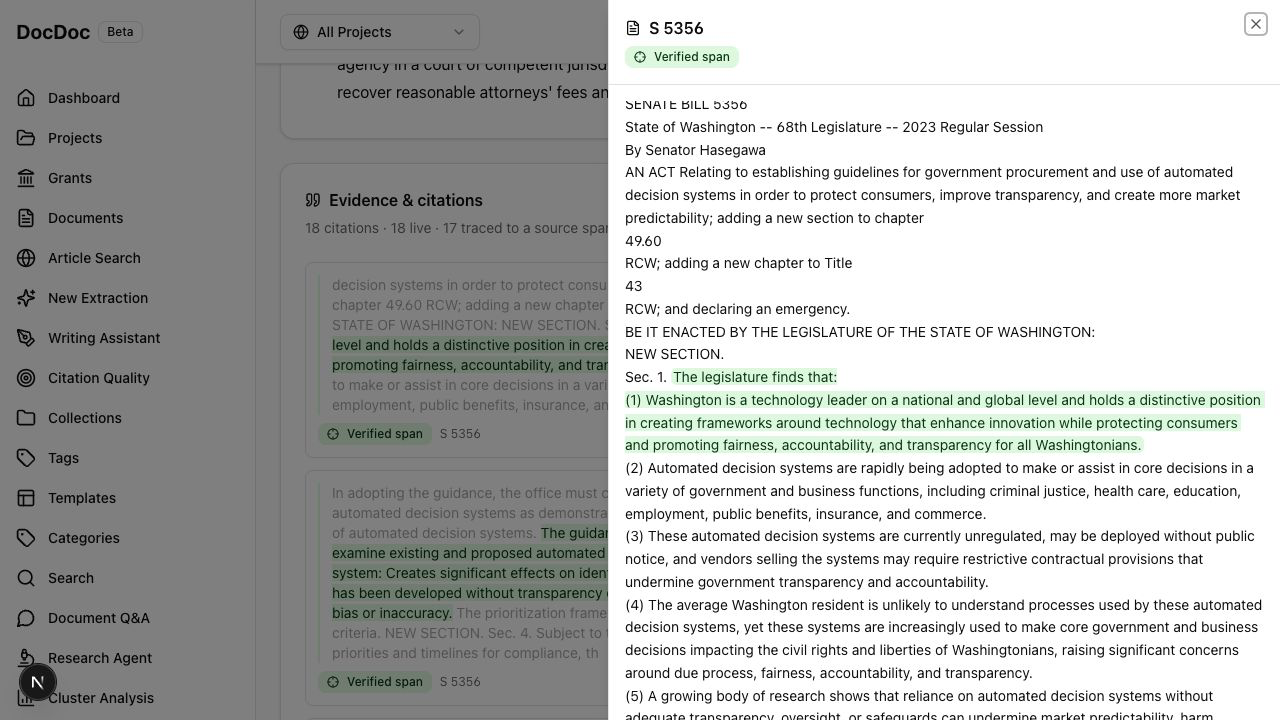
DocDoc operationalizes the lab’s research interests in human-AI collaboration, trustworthy agentic systems, and evidence-grounded knowledge work: every agent answer keeps its tool activity, citations, and verified source spans inspectable, which is the property the lab’s methods work argues AI research tools owe their users.
What it does today
- Runs tool-using research agents over an internal corpus, with run status, duration, and every LLM and tool call recorded and visible.
- Traces generated claims to verified source spans, and reports the tracing coverage rather than hiding gaps.
- Searches five scholarly providers at once and reports per-provider results, overlaps, and depth limitations in the interface.
- Ingests, parses, chunks, embeds, and searches document collections, with structured extraction workflows.
- Supports rich-text and LaTeX writing with in-text citations, APA reference lists, and review controls.
What it does not do
- No public deployment, signup path, or demo; DocDoc runs as a private internal workbench.
- Modules vary in maturity: at capture time the extraction-results route returned a 404, and the writing workspace showed stale word and citation counters.
- Not fully offline: local-first inference notwithstanding, some workflows call external scholarly-data services.
What it does not show yet
- No completed user pilot, external user feedback, public paper, or grant attribution is claimed, because none was verified for this entry.
- Provenance is not flawless across every module; the evidence panel itself reports when a citation lacks a verified span.
- “DocDoc” is a working name, not a product brand.
Outcomes
- Demonstrates that the lab can build the full research infrastructure around AI (document pipelines, retrieval, agent tooling, durable run records, and span-level provenance), not just text generation.
- Serves as an experimental platform for studying how much autonomy research agents should have and how provenance stays visible from discovery through writing.
Limitations and responsible use
- The repository and internal deployment stay private. Active grant materials, unpublished manuscripts, project and corpus names, and configuration details are excluded from all published captures.
Evidence
- Working internal prototype
- A running local application with functional document, search, research-agent, citation, and writing workflows over populated internal corpora, implemented as a Next.js frontend with a FastAPI backend, PostgreSQL with pgvector, a typed tool-calling agent runtime, and local Ollama inference.
- Captured evidence set
- Six screenshots captured from the running application, using public legislative and scholarly material over a populated internal workspace of 19 projects and 3,780 documents; five are published here, and one was held back for stale interface counters.
Maintenance
- Maintained by
- IDEEAS Lab
- Status
- Actively developed
- Last reviewed
- August 28, 2026