
SkillBridge
SkillBridge helps graduate students translate academic work into a reviewable, evidence-backed portfolio of workforce-relevant skills.
Built on our work in careers: The Engineering Master's Workforce: Leveraging Natural Language Processing Techniques to Understand Employer Demands and Student Goals.
The problem
The language of academic experience does not map cleanly to the language employers use. Graduate students build sophisticated capabilities through research, teaching, and projects, then struggle to name them in workforce terms, and AI tools that do it for them usually cannot show their evidence.
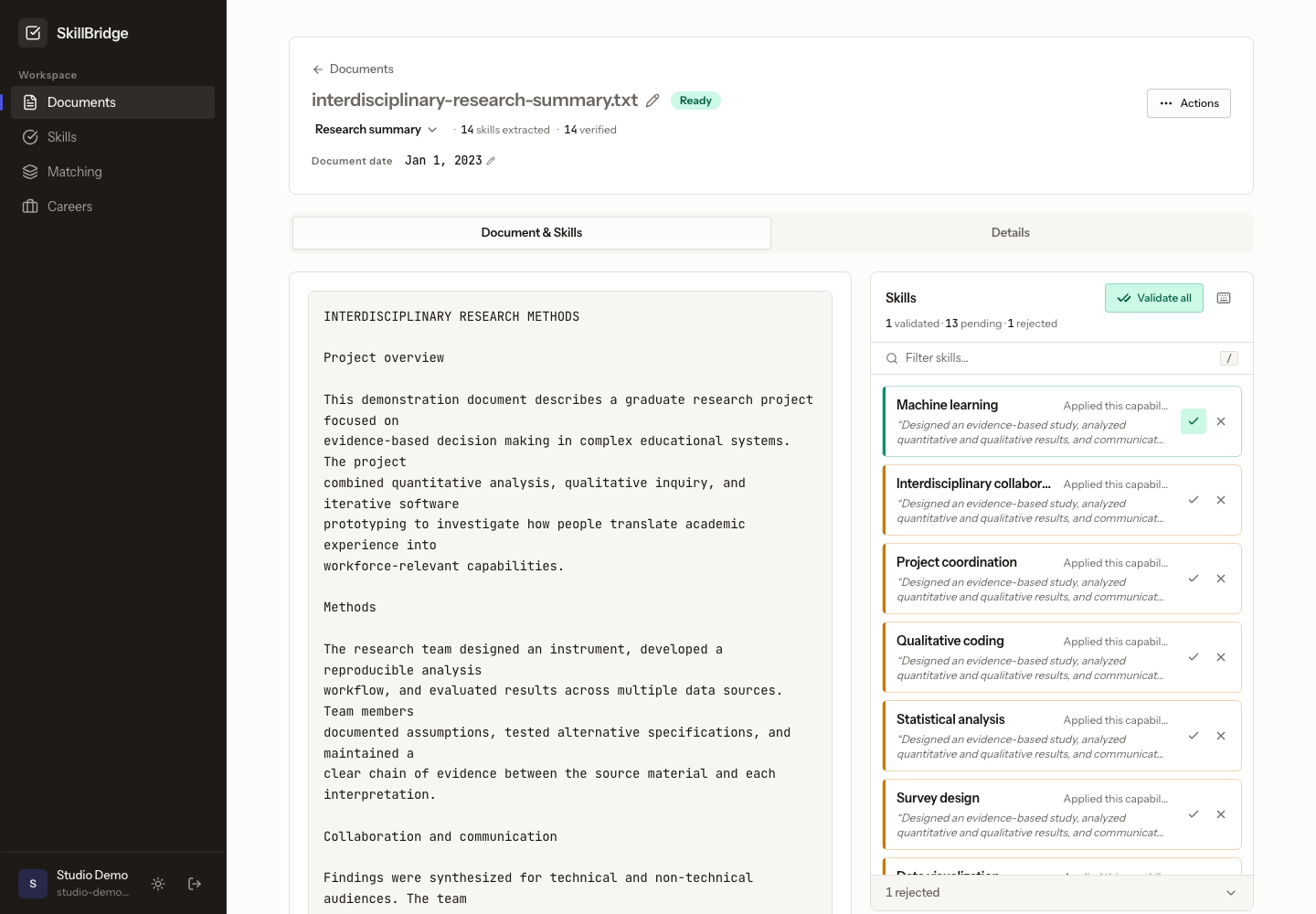
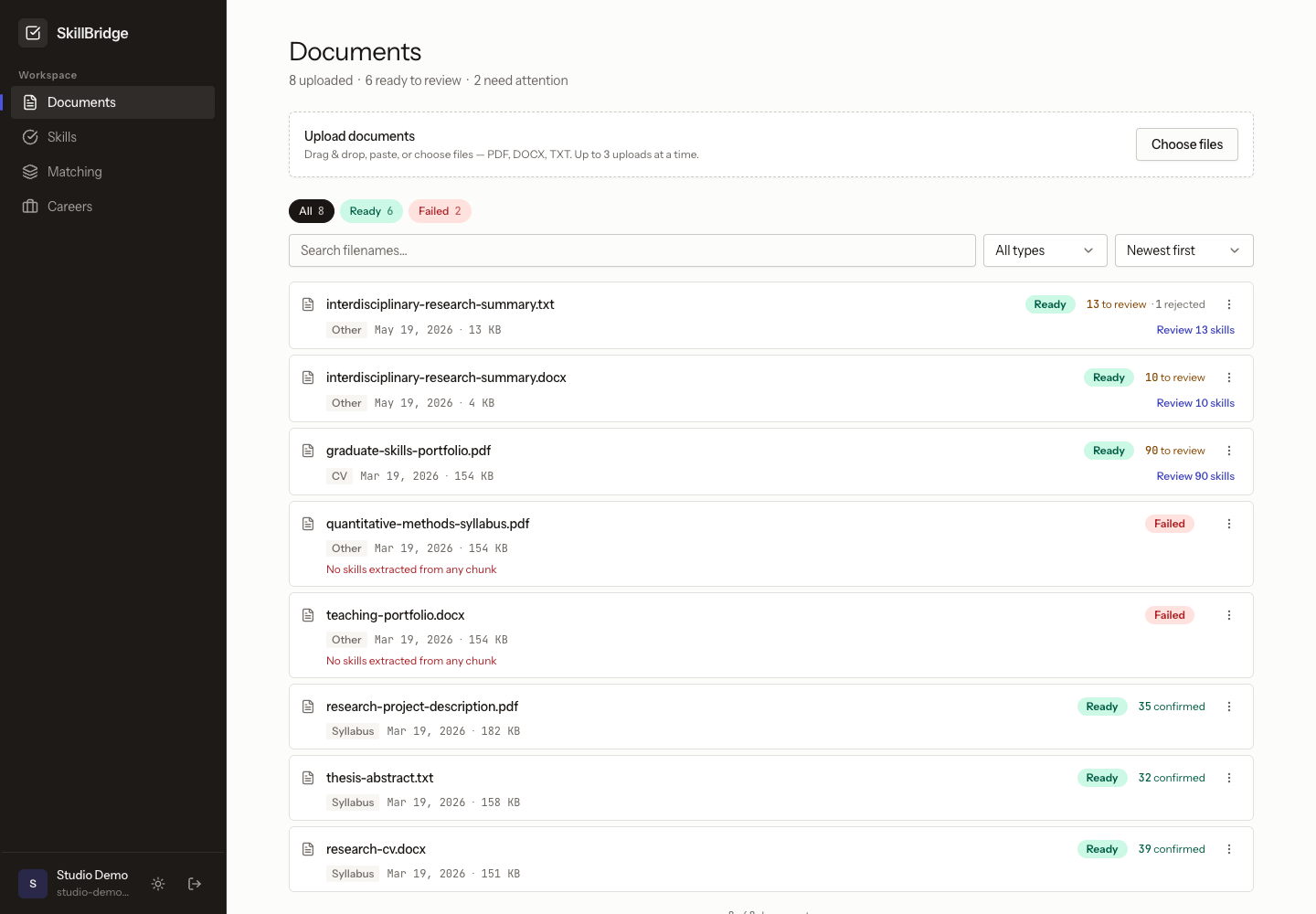
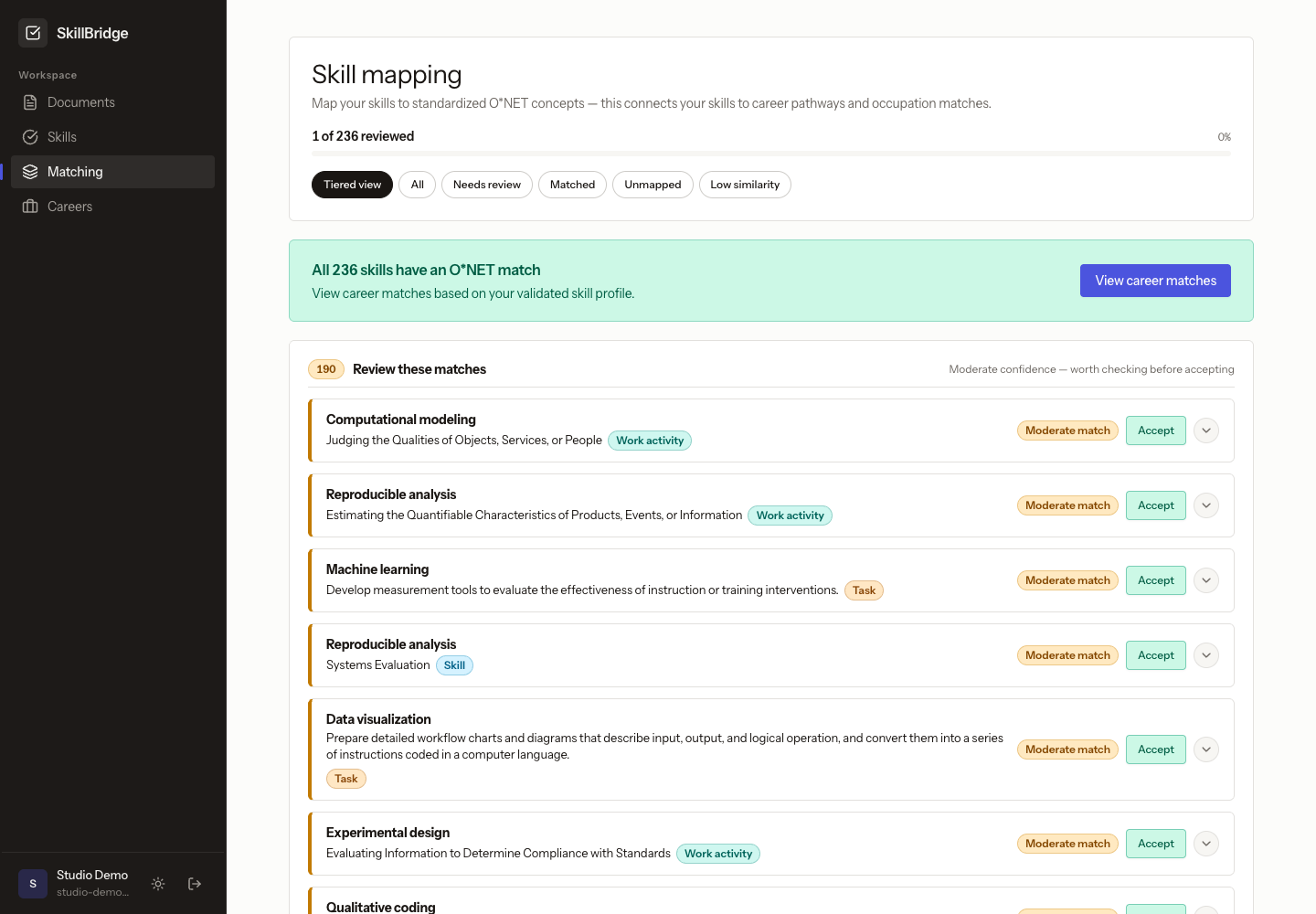
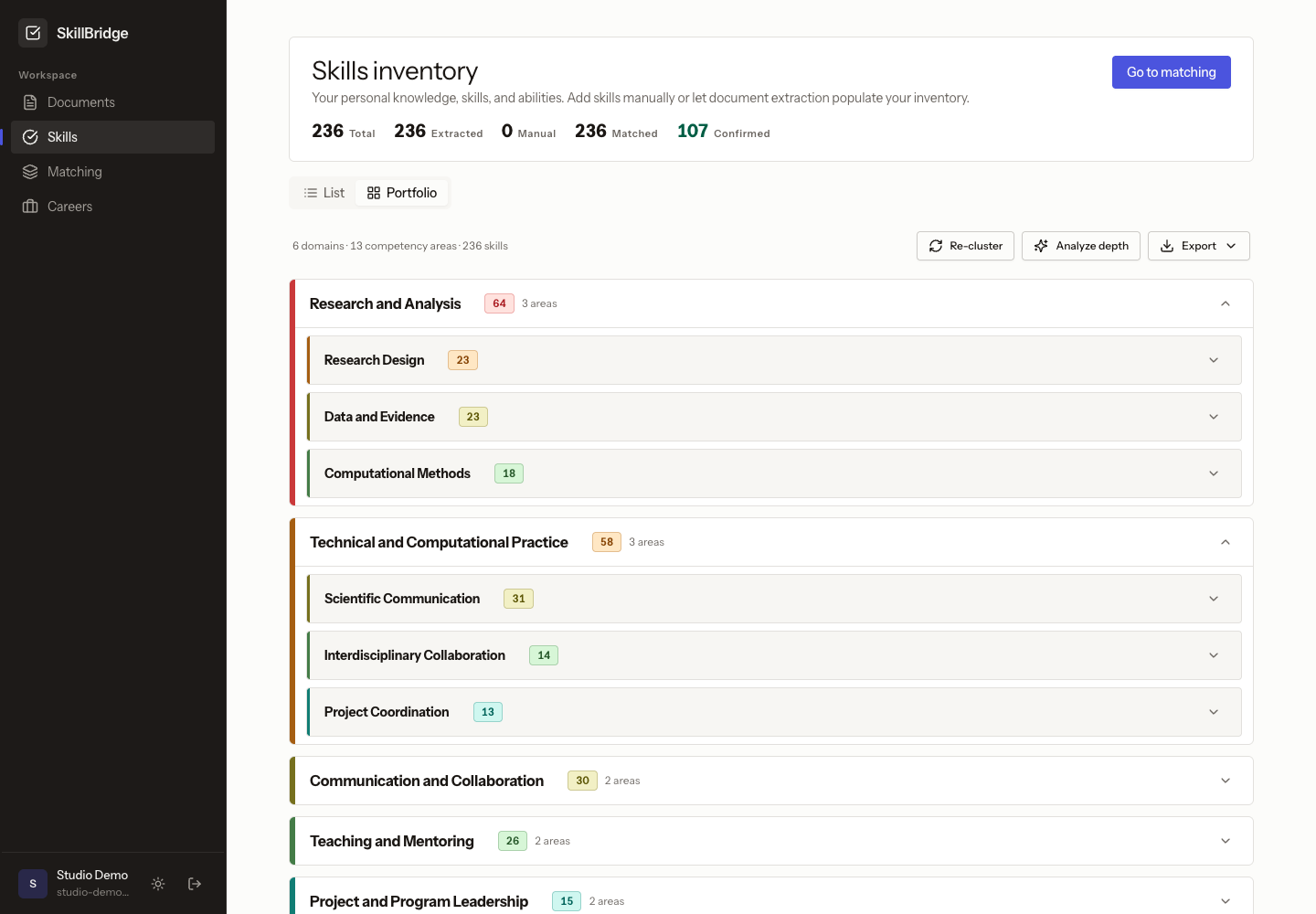
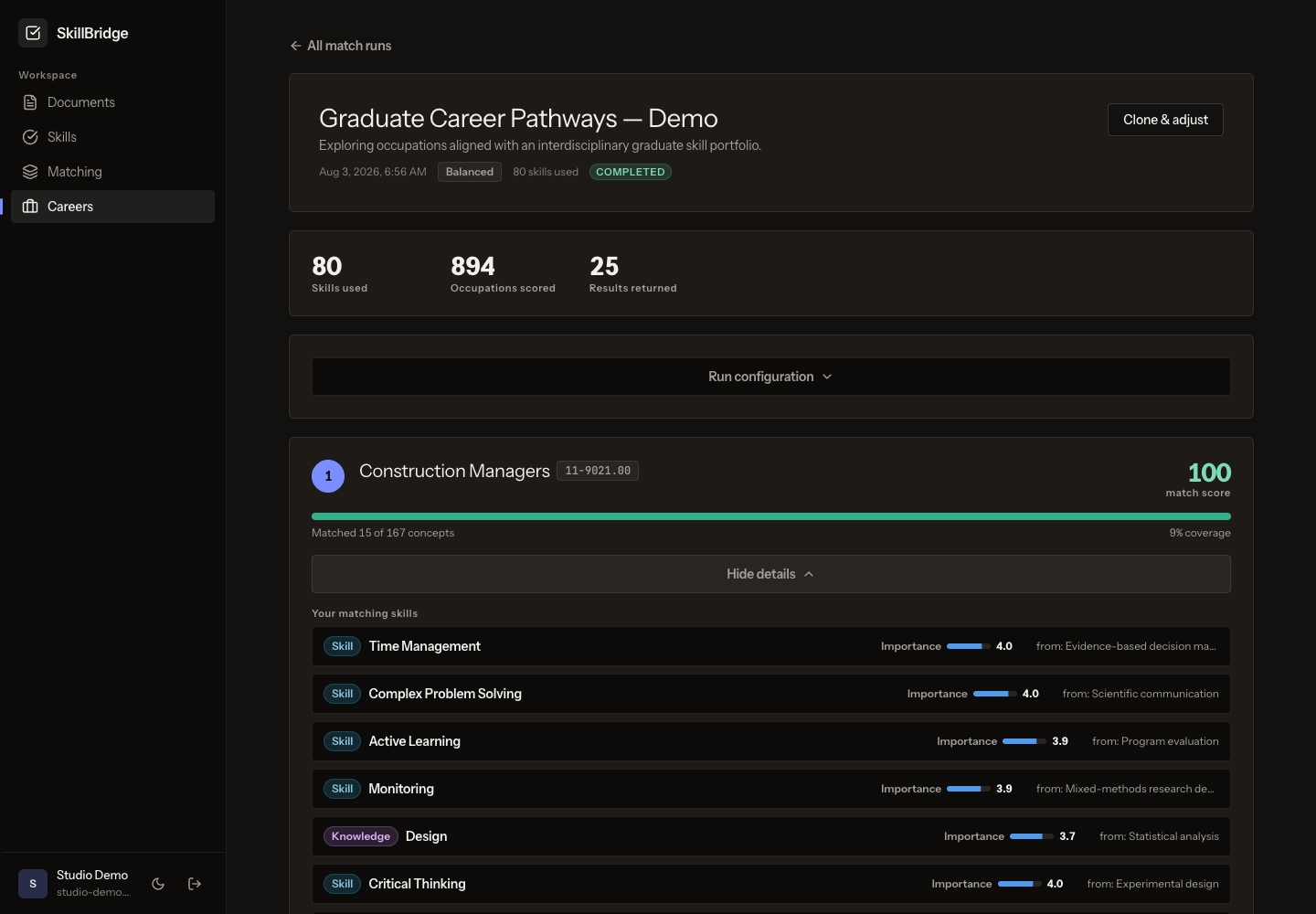
Upload syllabi, CVs, research summaries, thesis abstracts, and portfolios; a locally hosted language model extracts candidate skills and preserves the exact source passages behind each one. Users accept, reject, edit, or remap every suggestion, organize validated skills into a clustered portfolio, and run configurable matches against the O*NET occupational taxonomy, with each match explained by which skills drove it.
What it looks like
Research basis
SkillBridge connects the lab’s graduate career-readiness research to a working system, and points at a measurement question the lab takes seriously: the extraction pipeline is an individual feedback tool today, not a validated research instrument. The path from one to the other (a human-coded gold set, calibrated no-match behavior, reproducibility controls, an instrumented syllabus pilot) is designed and deliberately not yet claimed.
What it does today
- Uploads and parses academic and professional documents (PDF, DOCX, TXT) with asynchronous processing.
- Extracts candidate skills with a locally hosted language model, preserving the source passage behind every suggestion.
- Maps reviewed skills to the O*NET taxonomy by semantic search over 20,000+ embedded occupational concepts.
- Supports accepting, rejecting, editing, and remapping every suggestion: the user validates, the model proposes.
- Clusters validated skills into a hierarchical competency portfolio with cross-document evidence and development over time.
- Runs configurable occupation match runs with explainable, skill-level results.
What it does not do
- Not publicly deployed; development authentication only, no university SSO.
- No job-posting ingestion, individual-job matching, gap analysis, or application-narrative generation; those are planned, not implemented.
- No documented external pilot or formal usability study. Internal smoke testing reshaped the matching workflow, but that is not evaluated user research.
What it does not show yet
- SkillBridge does not claim to accurately measure a person’s skills, to produce valid or unbiased measurements across populations, or to improve career outcomes. It surfaces evidence-backed candidates for the person’s own judgment.
- It matches validated skills to occupations, not to individual job postings. That is the distinction between what exists and what is planned.
- Local inference is a privacy posture, not a security certification; the prototype is not production-secure or institutionally deployable.
Outcomes
- Demonstrates an end-to-end AI research platform: local inference, semantic search over 20,000+ occupational concepts, asynchronous document processing, and provenance-preserving human review.
- Provides a foundation for studying which capabilities engineering curricula claim to develop and how those claims align with occupational taxonomies.
Limitations and responsible use
- Uploaded documents, parsed text, source passages, and user profiles stay private; the demonstration corpus is synthetic.
- Job-posting data (NLx) is not ingested or shown: storage and reuse rights require written confirmation first, and the planned corpus work needs an IRB determination before being described as a study.
Evidence
- Verified working prototype
- 241 frontend and 140 backend tests passing (13 skipped), an optimized production build, and a health check reporting PostgreSQL, Redis, MinIO, the local language model, and O*NET embeddings ready, all verified when the studio package was prepared.
- Real interface, sanitized data
- Twenty screenshots captured from the running application by a scripted process that replaces user names, filenames, passages, and skill wording with synthetic demonstration content, reproducible from the repository.
- Occupational data at scale
- 20,441 O*NET concepts loaded and embedded for local semantic matching in the development environment.
Related research
Maintenance
- Maintained by
- IDEEAS Lab
- Status
- Validation and job-explorer work ahead
- Last reviewed
- August 28, 2026